
Why Cybersecurity is Becoming Part of the Traffic Signal Control Decision
A traffic signal controller is no longer necessarily an isolated piece of equipment operating from a cabinet at the intersection.
Modern signal systems may communicate with central management platforms, remote users and other connected transportation infrastructure. Engineers still need dependable phase timing, preemption, priority and intersection logic, but agencies also have to consider how those systems communicate, who can access them and how that access is authenticated.
That is the problem behind Q-Free Dynamic Signals, Q-Free’s new traffic signal controller software. Dynamic Signals is built on the signal-control logic of Q-Free’s MAXTIME software while adding encrypted communications, secure API connectivity and centralized access controls intended for modern connected networks.[1][2]
The reason the distinction matters is because cybersecurity at the intersection is increasingly an operational consideration, not solely an IT concern.
What Is Dynamic Signals?
Dynamic Signals is the traffic signal control module within Q-Free’s Dynamic Software family. It runs locally at the intersection and is designed for ATC-compliant Linux operating systems.[2]
From a traffic engineering standpoint, the software retains the type of functionality expected from an advanced signal-control platform. Q-Free’s product documentation identifies support for up to 40 phases, multiple ring-and-barrier sequences, preemption routines, transit and freight priority and advanced overlap configurations. It also supports applications including single-point urban interchanges, continuous-flow intersections, diverging diamond interchanges, HAWK signals, queue-responsive operation and compound intersections.[2]
That same signal logic is important to understanding the product. Dynamic Signals is not a cybersecurity layer added in place of traffic-control functionality. Q-Free developed the software around both requirements.
The interface is web-based, with an onboard web server that does not require a proprietary database editor. Q-Free also provides ATSPM-driven report dashboards, status replay and the ability to maintain multiple timing databases.[2]
For agencies already using Q-Free hardware, THP’s traffic signal controller information provides additional context on the ATC controller platforms used at the intersection.
Why Cybersecurity Belongs at the Intersection
The traffic signal industry has traditionally depended on communication methods developed under very different networking conditions.
Q-Free specifically identifies legacy SNMP-based communications as one of the issues Dynamic Signals was designed to address. Instead, Dynamic Signals uses encrypted web sockets and HTTPS for encrypted, authenticated communications. Q-Free also identifies encrypted web-based remote access and a secure API as part of the architecture.[1][2]
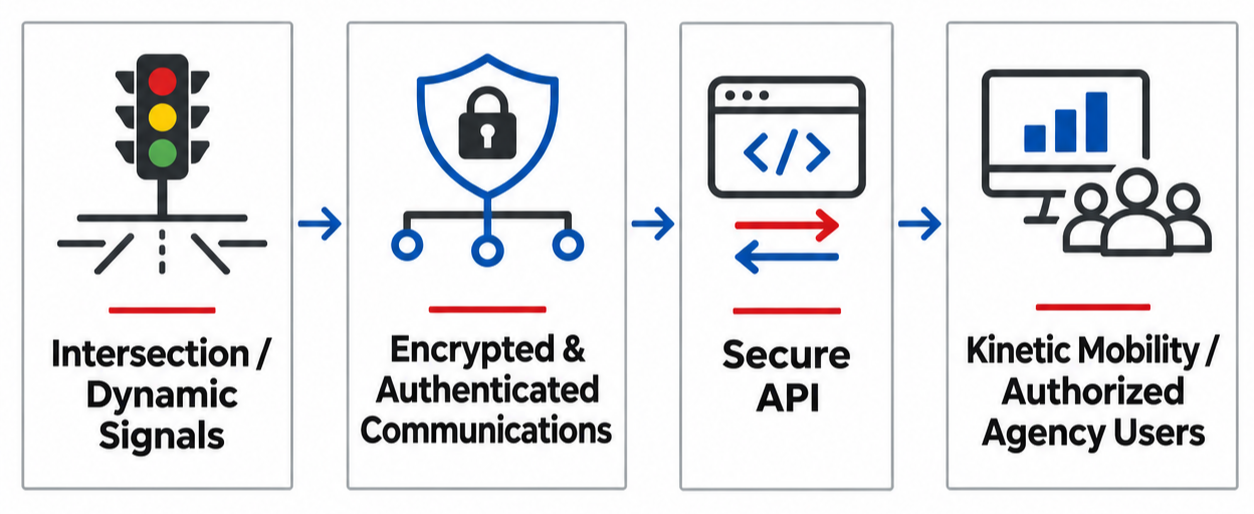
Dynamic Signals Architecture
Q-Free specifically identifies legacy SNMP-based communications as one of the issues Dynamic Signals was designed to address.
For a transportation agency, the importance of that architecture becomes clearer when the signal system is considered part of a larger operational technology network.
The Cybersecurity and Infrastructure Security Authority (CISA) and several international cybersecurity authorities have warned that connecting operational technology to IoT devices, cloud systems, AI applications and other smart-city infrastructure expands the digital attack surface. Their guidance specifically identifies traffic management as an example of infrastructure automation where additional sensors, remote access points and network connections can introduce new vulnerabilities.[3]
The real-world concern is therefore larger than someone gaining access to a piece of software.
Traffic signals control physical movements. Loss of availability could interfere with normal system operation. Loss of integrity raises a different concern: whether the information or commands moving through the system can still be trusted. Unauthorized access creates questions about who is able to view or alter system configurations.
CISA recommends that connected infrastructure be designed around principles that include authenticated access, least privilege, secure connectivity and defense in depth.[3] Dynamic Signals does not, by itself, constitute an agency-wide cybersecurity program. Its relevance is that security controls are incorporated into the controller software and its communications rather than depending entirely on protections elsewhere in the network.
AI Is Changing the Cybersecurity Environment
Artificial intelligence adds another reason transportation agencies are reviewing the security of connected infrastructure.
The U.S. Government Accountability Office reported in November 2026 that advancements in generative AI have increased the precision, accuracy, and speed of cyberattacks. GAO found that AI can magnify the reach and impact of established cyberattack methods while also giving defenders new tools for identifying vulnerabilities and analyzing network information.[4]
That does not mean an AI system is currently taking control of traffic signals, nor would it be accurate to claim that Dynamic Signals is an “AI attack prevention” product. Transportation networks already contain operational technology, connected devices and remote access. CISA has warned that artificial intelligence and other complex digital systems can introduce additional attack vectors into connected infrastructure. It also specifically identifies automated traffic management as one of the types of infrastructure operations affected by increasing connectivity.[3]
At the same time, AI can make traditional cyber activity faster and more capable.[4]
For traffic agencies, this changes the risk calculation around controller communications. A protocol or access method should not be considered adequate simply because it has operated without incident for years. The question increasingly becomes whether communications are encrypted, whether users are authenticated and whether access can be managed according to current agency IT requirements.
Those are areas Dynamic Signals was specifically designed to address.
Secure APIs Without Closing the System
Cybersecurity can create another engineering concern: interoperability.
Traffic agencies rarely operate every component of an ITS network from one manufacturer. Controller software may need to exchange information with central management software, agency systems or other ITS applications.
Dynamic Signals uses a secure API architecture for those connections rather than relying solely on legacy communications. Q-Free describes the platform as supporting secure, open integration across connected infrastructure while maintaining authenticated and encrypted communications.[1][2]
Why is that seperation important? Open integration and unrestricted access are not the same thing.
A modern API can provide a defined method for authorized systems to exchange information while authentication controls determine who or what is permitted to make that connection. For engineers, integrators and agency IT teams, the API becomes another item that can be evaluated during system design rather than an undocumented connection added after deployment.
Centralized Access Through Kinetic Mobility
Local security also becomes harder to manage as the number of intersections grows.
A few isolated controller accounts are different from hundreds of connected intersections with multiple traffic engineers, technicians, consultants and IT administrators requiring different levels of access.
Dynamic Signals integrates with Q-Free Kinetic Mobility for centralized authentication and user federation.[1][2] Q-Free positions this integration as a way to align local signal access with broader agency IT policies.
This is where Dynamic Signals connects naturally to central software. The controller still performs signal control at the intersection. Kinetic Mobility provides the broader management environment. Centralized user management means access does not have to be treated as an entirely separate administrative problem at every controller.
For larger agencies, local security becomes increasingly relevant as signal operations and IT responsibilities overlap.
Why Traffic Professionals Should Care
Cybersecurity can sound removed from the day-to-day work of timing an intersection until the controller itself becomes part of the connected network. Dynamic Signals brings those two disciplines closer together.
Traffic engineers still need advanced signal logic for phasing, pedestrian operation, preemption, transit priority and complex geometries. IT teams need authenticated users, encrypted communications and controlled network access. Agencies need systems that can exchange information without creating unnecessary exposure.
Dynamic Signals is Q-Free’s attempt to address those requirements in the controller software itself.
It does not eliminate the need for network segmentation, agency cybersecurity policies, account management, patching, monitoring or other security controls. No individual traffic product can provide that.
What it changes is the starting point.
Instead of treating cybersecurity as something added around legacy signal-control communications, Dynamic Signals begins with encrypted and authenticated communication as part of the software architecture.
As traffic control becomes more connected, and as AI increases both the capability of transportation systems and the capability of cyber threat actors, that distinction deserves attention during the same specification discussions as controller functionality, signal logic and central management.
Texas agencies, consultants and contractors evaluating Q-Free signal control can use Texas Highway Products’ Q-Free resources to review the broader controller and software portfolio or discuss product documentation and system requirements with THP.
References & Technical Resources
[1] Q-Free. (2026). Dynamic Signals. Q-Free Traffic Management Solutions.
Q-Free Dynamic Signals product page
[2] Q-Free. (2026). Dynamic Signals Product Sheet. Traffic Management Solutions. Current product sheet accessed November 23, 2026.
Dynamic Signals Product Sheet
[3] Cybersecurity and Infrastructure Security Agency, National Security Agency, Federal Bureau of Investigation, and international cybersecurity partners. (April 19, 2023). Cybersecurity Best Practices for Smart Cities. Cybersecurity and Infrastructure Security Agency.
Cybersecurity Best Practices for Smart Cities
[4] U.S. Government Accountability Office. (November 20, 2026). AI and Cybersecurity: Technologies Can Magnify Cyberattacks and Enhance Cyber Defense. GAO-27-108458.
GAO AI and Cybersecurity report