
What Agencies Should Specify Before Deployment
The lane closure may be fixed on the traffic control plan, but the queue behind it is not.
Its location changes with traffic volume, time of day, incidents, weather, construction activity, and driver behavior. A warning sign placed for the expected condition may be several miles from the actual back of queue later in the day. That difference is one of the reasons Intelligent Transportation Systems have become increasingly relevant in work zone traffic management.
TxDOT describes Smart Work Zones as the use of ITS equipment and the information it produces to support safety and mobility within and around highway work zones. The agency also makes an important distinction: Smart Work Zone systems supplement established traffic control requirements. They do not replace the Texas Manual on Uniform Traffic Control Devices, TxDOT standards, or the engineering process used to develop a traffic control plan.
The question is what condition needs to be detected, what response should occur, and how the system will be monitored throughout construction.
A Smart Work Zone Is a System, Not a Message Sign
FHWA identifies work zone ITS applications that include traffic monitoring, traveler information, incident management, safety, capacity management, enforcement, and performance measurement. The MUTCD specifically recognizes portable changeable message signs for conditions such as substantial speed reductions, significant queues, closures, adverse conditions, incidents, and changes in road-user patterns. It also notes their value for displaying real-time information before motorists reach a decision point.
In a Ver-Mac Smart Work Zone, field sensors or other traffic data sources collect information such as speed, volume, and occupancy. That information is transmitted to JamLogic, where project-specific logic evaluates current conditions. Predetermined messages can then be sent to connected roadside devices, including portable changeable message signs and speed-management equipment. Ver-Mac states that the system can also provide equipment status information, event history, alerts, and real-time data feeds.
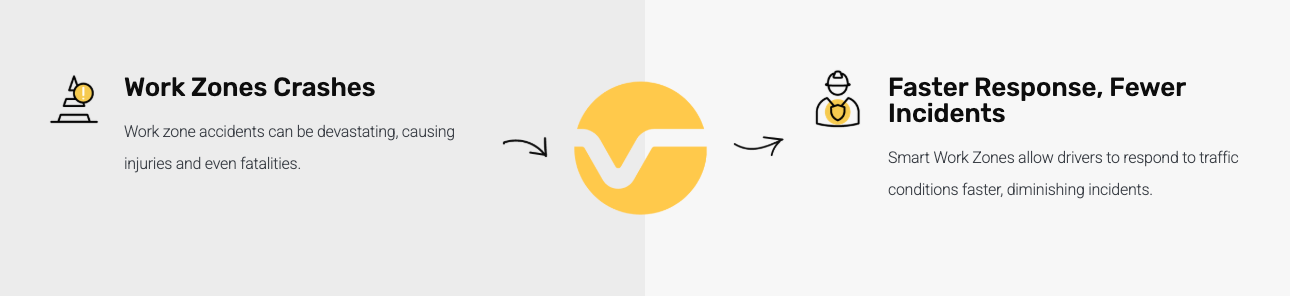
A project can have connected signs and still provide poor information when detection locations, thresholds, communications, or message logic do not match field conditions.
Transportation professionals evaluating Ver-Mac equipment can review the Texas Highway Products Smart Work Zones page for current product information and available work zone equipment.
Start With the Condition the Project Needs to Manage
Smart Work Zone applications are not interchangeable.
A corridor with recurring end-of-queue crashes presents a different operating problem than a project where motorists need reliable travel-time information before an alternate-route decision point. A work zone with frequent haul-truck movements introduces another conflict. A major lane closure with long peak-period queues may require another strategy altogether.
Ver-Mac identifies several applications within its Smart Work Zone platform, including queue warning, travel-time and alternate-route information, dynamic late merge, truck-entry warning, and speed management. Each application uses similar connected-system principles, but the detection logic and driver information are different. Ver-Mac
Queue warning is a useful example.
A queue warning system monitors downstream traffic conditions and changes the warning provided upstream as speeds deteriorate or a queue develops. FHWA describes these systems as using real-time detection to identify slow or stop-and-go conditions and activate appropriate warnings upstream.
The safety case is also supported beyond manufacturer literature. The USDOT ITS Deployment Evaluation program, updated in 2025, summarizes a Texas study in which an end-of-queue warning system was associated with an 18 to 45 percent reduction in crash potential and a 17 percent reduction in the proportion of lane-closure crashes classified as high severity. Those results belong to the studied deployment and should not be treated as a guaranteed outcome for every project.
The procurement lesson is more important than the percentage. The system needs to detect the condition that creates the risk and provide the warning far enough upstream for motorists to respond.
Define the Logic Before Selecting the Hardware
TxDOT’s Smart Work Zone Guidelines recommend identifying project-specific needs early, selecting the appropriate Smart Work Zone system, and establishing functional requirements before detailed design progresses. The guidance states that high-level Smart Work Zone design information should begin entering the roadway or bridge design process at approximately the 30 percent design stage. Although the guideline was published in 2018, TxDOT continues to reference it through its current Smart Work Zone and work zone traffic-control resources. That timing is important.
Waiting until construction to decide how the system should operate can leave fundamental questions unresolved. Detection coverage may conflict with staging. Message signs may lack appropriate upstream placement. Communications may be unreliable at a particular location. Responsibilities for monitoring, relocation, maintenance, and data review may not be clear in the contract.
A useful specification should define more than model numbers.
The agency should establish the operating objective, detection locations, triggering thresholds, approved message sets, sign locations, communications expectations, data requirements, system-health monitoring, and responsibility for changes as traffic control phases move.
For a queue warning system, for example, a specification may need to address what speed or traffic condition constitutes a queue, how the system distinguishes slow traffic from stopped traffic, how far warnings should be placed upstream, and how field devices will be relocated as construction progresses.
Ver-Mac notes that JamLogic uses project-specific algorithms and predetermined messages approved by the project engineer or agency. That distinction keeps the engineering decision with the owner and designer rather than treating automated messaging as an uncontrolled field function.
Readers evaluating the platform can also review Ver-Mac’s Smart Work Zone system overview for the manufacturer’s current architecture, applications, and hardware descriptions.
Credible Information Requires System Monitoring
Automated operation does not eliminate the need for oversight.
TxDOT’s Construction Contract Administration Manual directs project engineers to monitor Smart Work Zone systems to confirm that they are activating correctly and providing accurate, credible information to motorists.
A warning system loses value when the device is offline, the sensor is pointed at the wrong lane after a traffic switch, or a message does not match the condition motorists encounter downstream. Reliability therefore involves more than the physical durability of the sign or sensor.
Ver-Mac’s JamLogic platform provides remote equipment information including device mapping, event history, speed data, communications status, and power diagnostics. Optional email or text alerts can also be used for identified system conditions.
For an agency or contractor, those functions can support the operating responsibility established in the project documents. They do not replace field verification. They provide another means of identifying when a component requires attention.
Data Sharing
Work zone information increasingly has value beyond the roadside device displaying it. FHWA’s Work Zone Data Exchange was developed to give infrastructure owners and operators a common format for sharing work zone information with third parties. FHWA lists Texas among the jurisdictions with WZDx data feeds and notes that the specification supports work zone and smart work zone device information.
Ver-Mac states that Smart Work Zone data can be provided through an API using the FHWA Work Zone Data Exchange format and that information can be distributed to project stakeholders, traffic management centers, public websites, and navigation platforms.
That capability should still be evaluated against the requirements of the individual project. Agencies should identify what data they expect, who needs access, how frequently information is updated, and what interface is required by the owner’s existing systems.
Interoperability is useful only when the data being exchanged satisfies an actual operational requirement.
The Best Smart Work Zone Starts With a Defined Problem
Smart Work Zones provide agencies with more ways to respond to traffic conditions that change throughout construction. Their value comes from connecting detection, decision logic, communications, and driver information around a specific operational need.
For Texas projects, that means starting with the traffic problem, applying TxDOT’s Smart Work Zone guidance, developing clear functional requirements, and maintaining consistency with the traffic control plan and applicable standards.
Ver-Mac provides a connected platform that can support applications ranging from queue warning and traveler information to truck-entry warning and dynamic merge operation. The appropriate configuration depends on roadway conditions, staging, traffic demand, agency requirements, and the purpose of the deployment.
Texas Highway Products provides Ver-Mac work zone equipment and product information for agencies, consultants, and contractors evaluating these applications. For documentation, availability, or questions about equipment options, use the Texas Highway Products contact and quote page.
References
Federal Highway Administration. (2023). Manual on Uniform Traffic Control Devices for Streets and Highways, 11th Edition, Section 6L.05 Portable Changeable Message Signs. U.S. Department of Transportation.
https://mutcd.fhwa.dot.gov/pdfs/11th_Edition/mutcd11thedition.pdf
Federal Highway Administration. (2021). Work Zone Intelligent Transportation Systems: Technology Supplement. U.S. Department of Transportation.
https://ops.fhwa.dot.gov/publications/fhwahop21021/fhwahop21021.pdf
Federal Highway Administration. (n.d.). Intelligent Transportation Systems and Technology. Office of Operations. Retrieved October 8, 2026.
https://ops.fhwa.dot.gov/wz/its/index.htm
U.S. Department of Transportation, ITS Joint Program Office. (Updated November 2025). ITS for Work Zones: Queue Warning.
https://www.itskrs.its.dot.gov/briefings/executive-briefing/its-work-zones-queue-warning
U.S. Department of Transportation, ITS Joint Program Office. (n.d.). Essential ITS: Queue Warning. Retrieved October 8, 2026.
https://www.itskrs.its.dot.gov/benefits/essential-its/queue-warning
Texas Department of Transportation. (2018). Smart Work Zone Guidelines: Design Guidelines for Deployment of Work Zone Intelligent Transportation Systems. Traffic Safety Division.
https://ftp.txdot.gov/pub/txdot-info/trf/smart-work-zone-guidelines.pdf
Texas Department of Transportation. (n.d.). Smart Work Zones. Retrieved October 8, 2026.
https://www.txdot.gov/safety/smart-work-zones.html
Texas Department of Transportation. (n.d.). Work Zone Traffic Control. Retrieved October 8, 2026.
https://www.txdot.gov/business/resources/work-zone-traffic-control.html
Ver-Mac. (n.d.). Smart Work Zone Overview. Retrieved October 8, 2026.
https://www.ver-mac.com/en/smart-work-zones/smart-work-zone-overview/
Ver-Mac. (n.d.). JamLogic. Retrieved October 8, 2026.
https://www.ver-mac.com/en/smart-work-zones/software/jamlogic/
Ver-Mac. (n.d.). Queue Warning System. Retrieved October 8, 2026.
https://www.ver-mac.com/en/smart-work-zones/applications/queue-warning-system/
Texas Highway Products, Ltd. (n.d.). Smart Work Zones. Retrieved October 8, 2026.
https://www.texashighwayproducts.com/work-zones